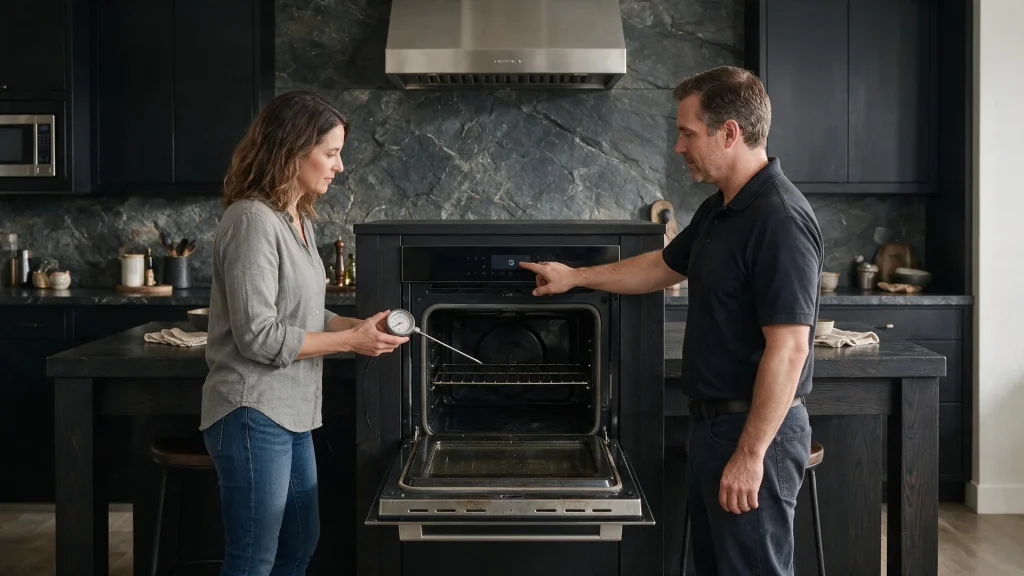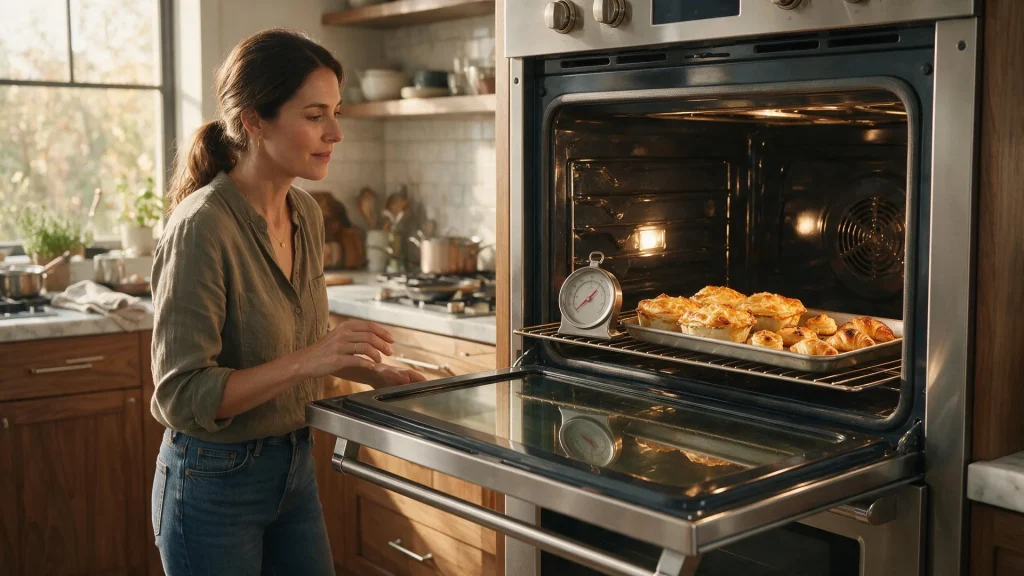
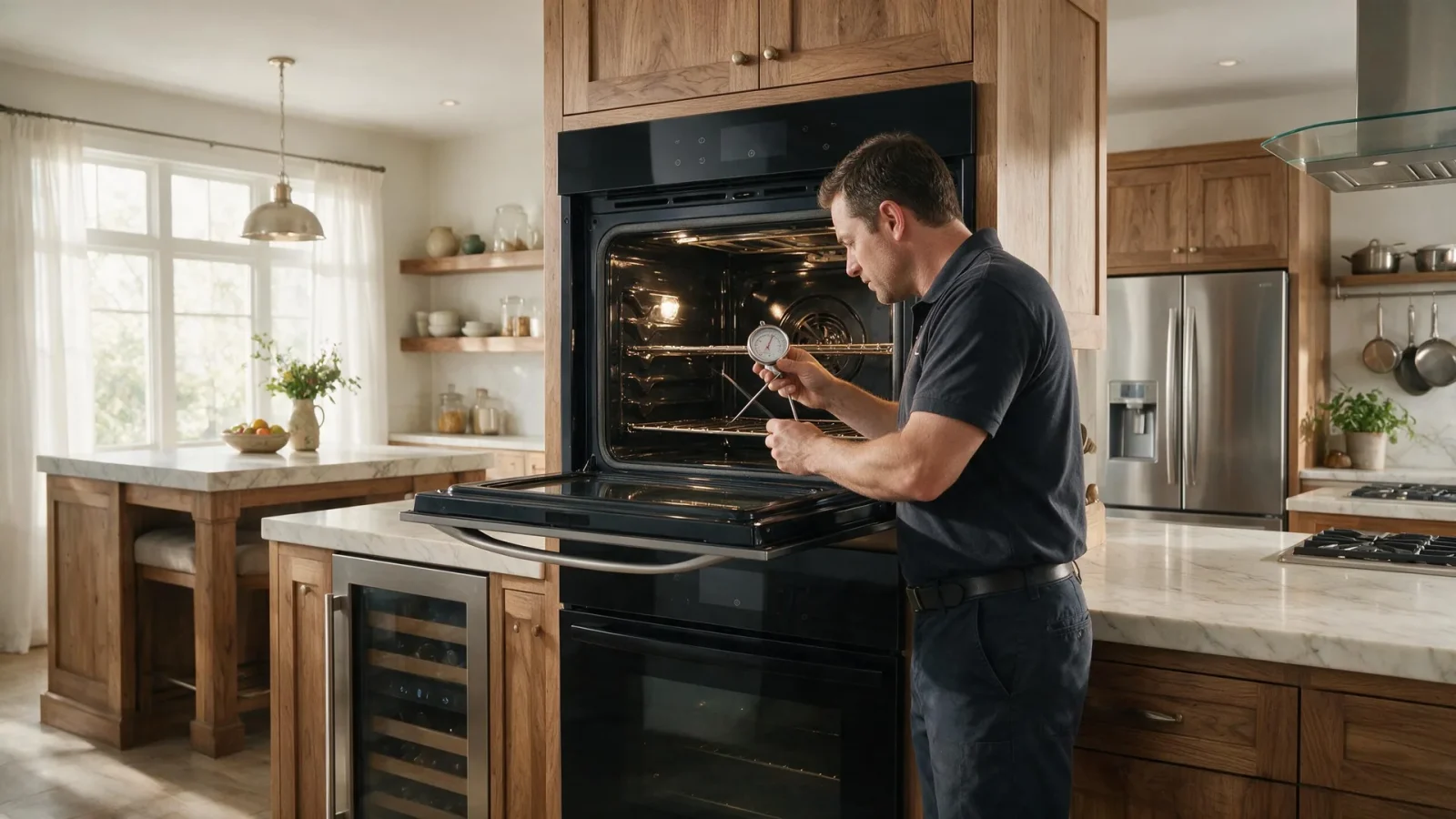

Ovens cycle above and below the setpoint. One instant thermometer reading can make normal cycling look like a calibration problem, so use a consistent method before changing settings.
A Dacor oven that seems to run too hot or too cold should be judged by several readings over a stable period, not one glance at a thermometer. If the average stays clearly off in the mode you actually cook in, a documented temperature adjustment may help, and a persistent offset beyond that is a service question.
Ovens cycle above and below the setpoint. One instant thermometer reading can make normal cycling look like a calibration problem, so use a consistent method before changing settings.
Troubleshooting works best when each check answers one question. Change one thing at a time, record the result, and stop before the next step requires internal electrical, gas, sealed-refrigeration or microwave high-voltage work.
Preheat fully and avoid checking immediately after opening the door. Letting the oven settle for a short while after the preheat signal gives a steadier reading than testing at the first beep.
The use-and-care manual for one Dacor Modernist wall oven says oven temperature is calibrated at the factory and can be adjusted by plus or minus 35 F (19 C) under Settings, Temp, Temperature Adjust. The adjustment does not change broil or self-clean temperatures and is kept after a power failure.
That tells you two useful things. A change in baking results after a power event is not explained by a lost adjustment, and an adjustment made for baking will not fix a broil complaint. Check your own manual, since menus and ranges differ between models.
Do not rely on memory. Note the selected mode, setpoint or cycle and whether the appliance behaves differently under another normal condition.
Take multiple readings over a stable period at a consistent rack position.
| Symptom | What it can point to | What you can safely check |
|---|---|---|
| Food browns unevenly | Rack position or the mode used | Move to a recommended rack level and compare |
| Thermometer swings around the setpoint | Normal heating cycles | Average several readings with the door closed |
| Baking reads consistently high or low | Offset in the average | Review the temperature adjustment in your manual |
| Broil seems wrong but bake is fine | A broil-specific issue | Compare modes; the adjustment does not apply to broil |
| Display shows a sensor or high-temperature code | Sensor or control fault | Note the code and book service |
A comparison can narrow the problem without opening the appliance: one oven cavity versus the other, one burner versus another, refrigerator versus freezer temperature, or fill versus drain behavior.
Compare results across the cooking mode where the complaint actually occurs.
The Modernist manual says the convection fan normally cycles on and off during baking and that steam from the vent during convection baking is normal. Neither is a sign of a temperature problem. It also advises always preheating for baking, citing 5 minutes for several convection modes, and describes an InstantHeat mode that is used without preheating.
Keep this in mind when you compare results across modes, because a mode that skips preheating will give a different early reading than one that preheats first.
The manual’s troubleshooting entries for an oven that is too hot, too cold or does not bake properly point to the controls, rack position or level, and the temperature adjust setting. Work through those in that order before blaming a part.
Then stop and reassess. If the symptom has not changed, repeated resets or random parts replacement will usually add noise rather than useful information.
If the average remains clearly offset or cooking performance is repeatably wrong, model-specific calibration guidance or sensor/control diagnosis may be appropriate.
If you do reach that point, tell the service team which rack level and mode you tested and what the average was. A clear pattern, such as consistently high in convection but fine in bake, narrows the diagnosis before the visit starts.
Bring the model number and exact observations. If the appliance displays a Dacor code, photograph it before resetting and link the article to `/dacor-error-codes/` or the exact existing code page.
For adjacent symptoms, see Dacor Oven Turns On but Does Not Heat: Separate Control Response From Actual Heat and Dacor Oven Will Not Hold Temperature: What a Repair Estimate Should Actually Include.
Use `/services/dacor-oven-repair/` and `/appliances/dacor-built-in-ovens/` as the relevant internal routes where they genuinely help the reader.
For a range, wall oven, cooktop or rangetop, identify the exact zone, cavity and mode. A problem limited to one burner or one oven cavity is a different diagnostic pattern from a failure affecting every heating function.
Gas and line-voltage cooking appliances also have a clear DIY limit. User-accessible cleaning, cap seating, settings and observation are appropriate; internal ignition, valve, wiring, control and power testing belongs to qualified service.
Usually one normal manual-approved reset is enough to test whether the state was temporary. If the symptom returns, diagnose the cause.
Yes. Dacor has current and legacy model families with different controls, components and code behavior.
Prefer the existing Dacor model/error-code resources tied to the actual appliance family.
No. The Modernist manual says the adjustment does not change broil or self-clean temperatures.
The same manual says the adjustment is retained after a power failure. If results change after an outage, look for something else, such as a lockout or a changed mode.
No. Take several readings over a stable period in the mode where the complaint occurs, and only then consider an adjustment within the range your manual allows.
Dacor oven repair: common problems, safe checks, model and error-code resources, and when to book professional oven service.
Dacor built-in ovens: models, common problems, error-code resources, troubleshooting guides, and repair links in one model-aware hub.
An oven display can look normal while the cavity fails to heat. The useful distinction is whether the appliance accepts the mode, whether any…
An oven that preheats but will not maintain the set temperature can involve sensing, heating output, ignition, control behavior, door sealing or power conditions.…
A double oven provides a built-in comparison: one cavity can help show that the home still has power while the other has a local…
Share a few details and we’ll confirm an appointment. Prefer to talk? Call us and we’ll help right away.
Fields marked with * are required.