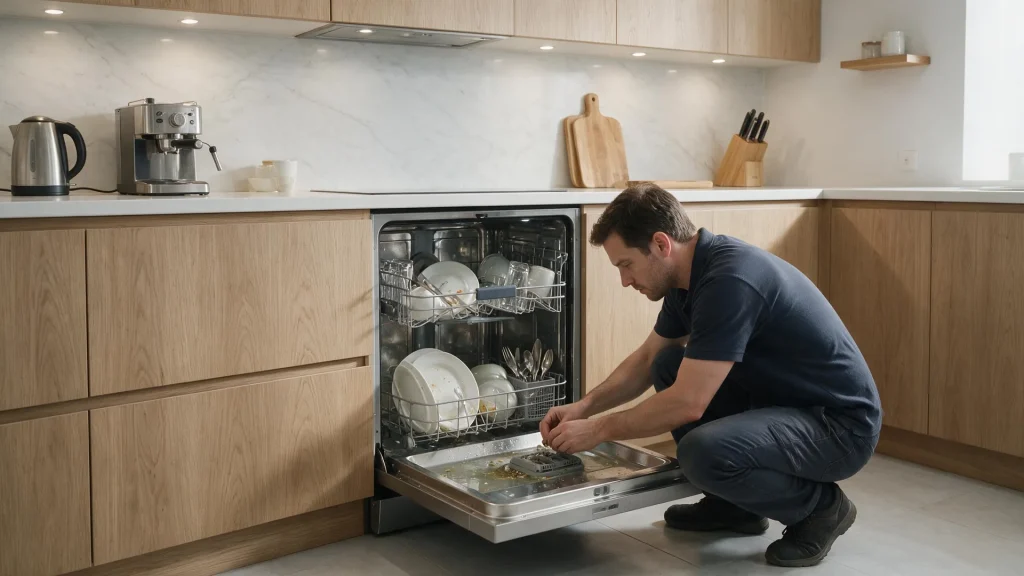

A dishwasher that does nothing can be caused by door/latch conditions, control lock, cycle selection or power. But a dead display after a breaker trip, burning odor or water exposure should not be treated like a…
A Dacor dishwasher that does nothing can be a latch, cycle or power question, but a dead control after a breaker trip, a burning smell or water near electrical parts is a stop condition. Check the door, cycle selection and Start first, and stop at the first sign of a safety issue.
A dishwasher that does nothing can be caused by door/latch conditions, control lock, cycle selection or power. But a dead display after a breaker trip, burning odor or water exposure should not be treated like a routine reset problem.
Safety symptoms outrank convenience. If there is persistent gas odor, smoke, sparking, a burning electrical smell, repeated breaker trips or water contacting electrical connections, stop using the appliance as appropriate and follow the relevant emergency/safety guidance.
The user manual for one Dacor 24-inch dishwasher lists the door fully latched, the upper rack properly joined to the duct nozzle, Start pressed, a cycle selected, the power cord connected and the water supply valve open. Several of these are quick and need no tools.
| Symptom | What it can point to | What you can safely check |
|---|---|---|
| No lights, no response | No power at the outlet or breaker | Check the home breaker only if it is safe to reach |
| Lights on, nothing starts | Door unlatched, no cycle selected or Start not pressed | Close the door, select a cycle, press Start |
| Starts late | Cold water supply needs time to heat | Allow the cycle extra time; see the manual |
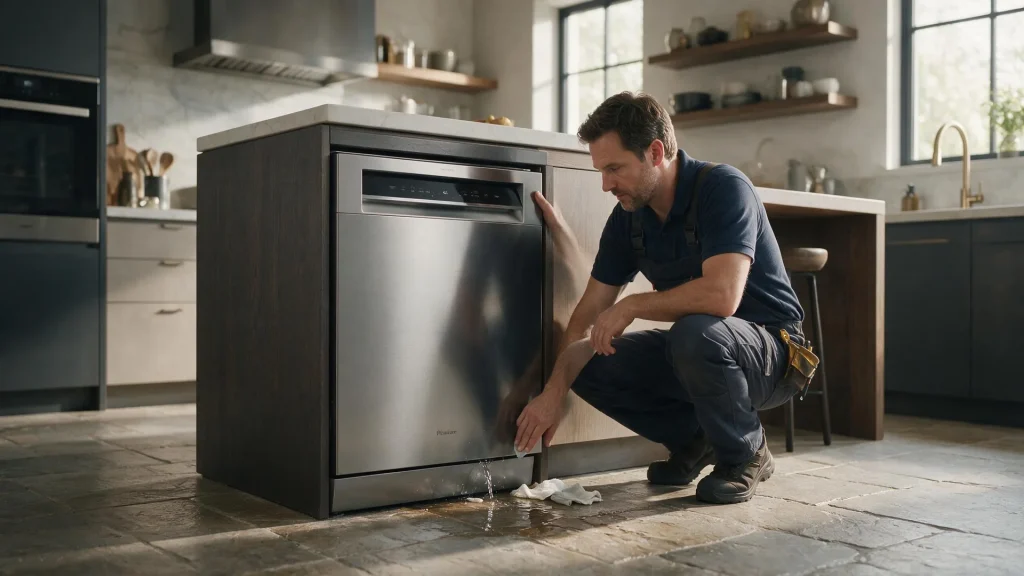
| Leak code appears | Leakage detected | Close the water supply, switch off the breaker and call the installer |
Keep the checks external and manual-approved. Do not remove electrical panels, defeat door switches, bypass safety devices, work on gas valves or lines, open a microwave cabinet, or perform sealed-refrigeration work.
Repeated breaker trips, heat at the plug, visible damaged wiring, smoke or water near electrical connections are stop conditions. Do not keep resetting the circuit to force the dishwasher to run. A dishwasher on a circuit that keeps tripping is a reason to stop, whatever the dishwasher itself seems to be doing.
A symptom can look minor while the next diagnostic step is not. Premium built-in products may place electrical, water and gas connections behind panels or cabinetry; moving the appliance without a plan can create a second problem.
If water is present, limit spread into cabinetry and flooring without reaching into electrical compartments. If the appliance is hot, allow safe cooling rather than forcing a latch or panel. If a gas appliance will not ignite normally, do not keep cycling it when gas odor is present.
The same manual lists code LC as a leakage check. It tells you to close the water supply, switch off the dishwasher breaker and contact the installer. Moisture on the leakage sensor is mentioned in its install leak-fix steps, so a leak code deserves a proper look rather than repeated restarts.
If the control went dead after a leak, treat the electrical side as unsafe. Do not keep restoring the breaker to see whether the dishwasher comes back.
For related guidance, read Standing Water in a Dacor Dishwasher: The Drain Problem Is Usually a Sequence, Not a Single Part and What Changes the Cost of a Dacor Dishwasher Leak Repair?.
Use `/services/dacor-dishwasher-repair/` and `/appliances/dacor-dishwashers/` for internal service/appliance links where appropriate. If an error code is displayed, link to the actual Dacor code resource rather than interpreting a generic code from memory.
A dishwasher symptom should be tied to the stage of the cycle. “Stopped working” is less useful than “fills but does not circulate,” “washes but leaves water at the end,” or “finishes but dishes remain wet.” If a code appears, photograph it and note whether it occurs during fill, wash, drain or drying.
Panel-ready installations should stay in place until service needs access. Pulling the unit without protecting water, drain, electrical and cabinetry connections can create a leak or alignment problem that was not part of the original complaint.
A dishwasher with a live display that will not begin is a different pattern from one with a dead display. The first points to door, lock, cycle or Start; the second to power or a deeper control issue.
If water is already in the tub, that manual describes holding Start for 3 seconds to cancel and drain. Do that before assuming the cycle is stuck, and report whether water remained.
Not when the intermittent symptom involves gas, smoke, sparking, burning odor, overheating, water near electricity or repeated breaker trips.
No. Internal electrical testing is not a homeowner check.
Record what happened. If a safety-related symptom returns, do not rely on repeated resets.
A single try after rechecking the door and cycle selection is reasonable. Repeated presses will not fix a power or control problem.
On the manual for one Dacor 24-inch dishwasher, LC is a leakage check. The manual says to close the water supply, switch off the breaker and contact the installer.
The manual says that with a cold water connection the dishwasher needs extra time to heat, so a late start can be normal.
Dacor dishwasher repair: common problems, safe checks, model and error-code resources, and when to book professional dishwasher service.
Dacor dishwashers: models, common problems, error-code resources, troubleshooting guides, and repair links in one model-aware hub.
Water left in the bottom of a dishwasher after the cycle can come from a blocked filter area, a kinked or restricted drain path,…
Dishwasher leak pricing depends on the leak path. Door-area water, a loose visible connection, a drain or fill problem, an internal pump/seal issue and…
Wet plastics do not automatically mean the dishwasher is broken. Drying results depend on cycle selection, rinse aid, loading, filter cleanliness, water conditions and…
Share a few details and we’ll confirm an appointment. Prefer to talk? Call us and we’ll help right away.
Fields marked with * are required.