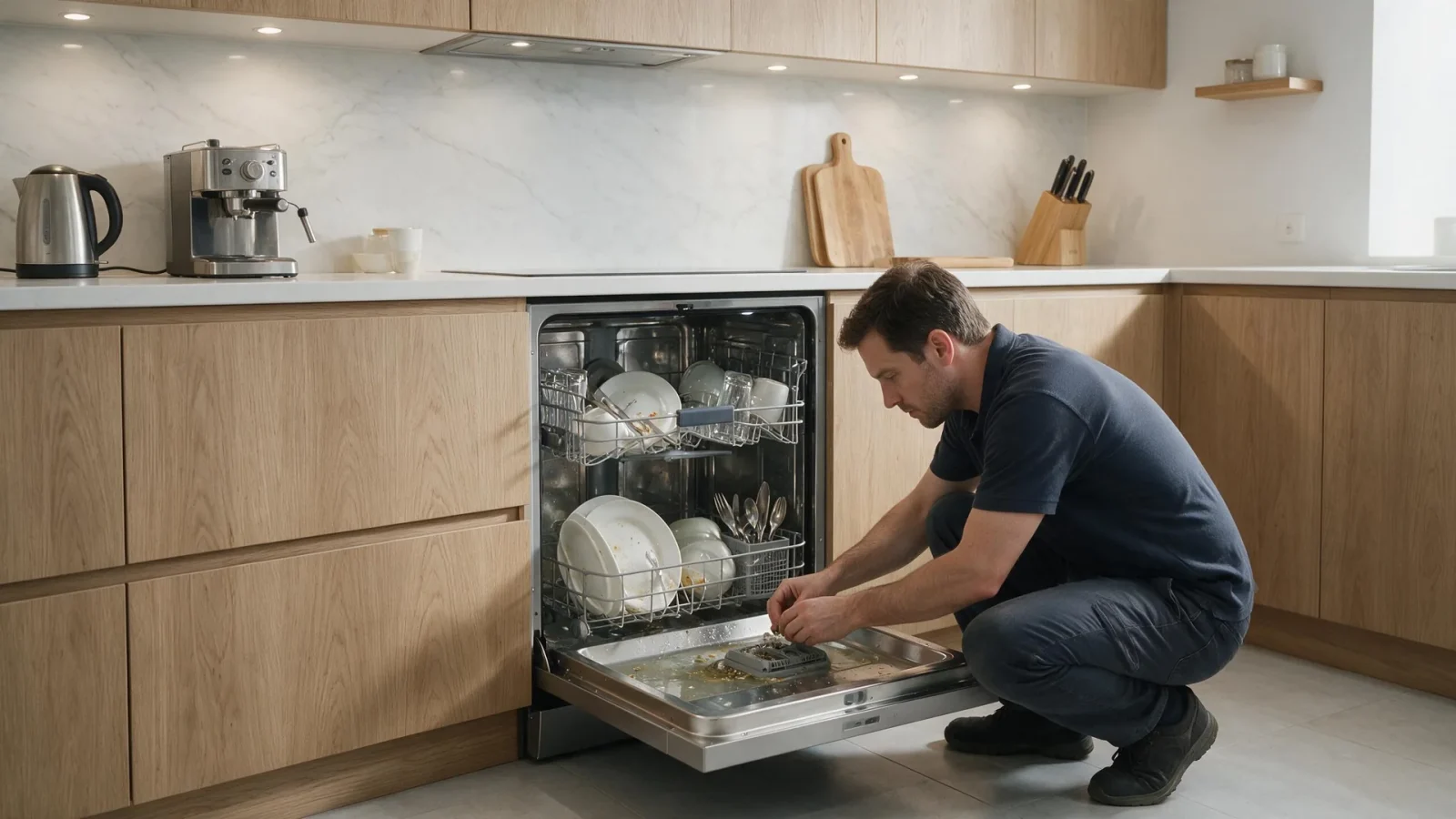

Water left in the bottom of a dishwasher after the cycle can come from a blocked filter area, a kinked or restricted drain path, installation conditions, a pump problem, or a cycle that never reached the expected drain…
Standing water in a Dacor dishwasher points to the drain path, and several parts of that path can be checked from the outside: a dirty filter, a folded drain hose, or a sink-side backup. Let the cycle finish, clean the filter and look at the visible hose. If water remains, or a code shows, the drain system needs testing.
Water left in the bottom of a dishwasher after the cycle can come from a blocked filter area, a kinked or restricted drain path, installation conditions, a pump problem, or a cycle that never reached the expected drain stage.
The useful question is not “which part is bad?” but “what pattern can you confirm without opening the appliance?” Dacor has current and legacy model families, so the same outward symptom can have different internal causes depending on the exact model and installation.
| Symptom | What it can point to | What you can check |
|---|---|---|
| A little water left after a finished cycle | Normal residual water or a filter that needs cleaning | Clean the filter as the manual describes and judge the level after the cycle ends. |
| Standing water plus a sink that drains slowly | A backup on the sink or disposal side, not the dishwasher | Run the sink drain on its own and see whether it clears. |
| Water remains and the drain hose is visibly bent | A folded or clogged drain hose | Check the visible hose run for kinks without pulling the dishwasher out. |
| A drain-check code appears | The machine has detected a drain problem | Follow the manual’s steps for the model; close the water supply before checking the drain area. |
Take a photo of any displayed code and write down the model number before resetting power. A code that disappears after a reset can still be useful to the technician, while repeated resets can erase the sequence that explains what happened.
A cycle moves through fill, wash and drain in order, and a fault at one stage can show up as a symptom at the next. A restricted filter, a folded hose, a drain pump area packed with debris and a pump problem can all leave the same pool of water, which is why the label on the symptom is rarely enough.
The 24-inch Dacor dishwasher manual lists a folded or clogged drain hose as the reason water remains after a cycle, and it describes a 5C drain-check code with steps to check the hose, clean the drain pump area and close the water supply while doing so. Other Dacor families may behave differently, so use the manual for your exact model.
Installation matters in premium kitchens. Built-in cabinetry, panel alignment, water/drain routing, gas or electrical supply and ventilation can influence performance without the appliance having the same internal problem as another unit with the same headline symptom.
That is why a useful diagnosis separates three layers: user-accessible conditions, installation conditions and internal component behavior. Start with the first two; leave live electrical, gas, sealed-refrigeration and microwave high-voltage testing to service.
If the machine hums, stops with a code, leaks, or repeatedly leaves significant water after the accessible checks, the drain system should be tested rather than parts being ordered from the symptom alone.
If the problem is repeatable, bring the model number, the exact operating mode and your observations to the appointment. That is more useful than ordering a part from a forum or from a generic symptom list.
On that same model, pressing and holding Start for 3 seconds cancels the cycle and drains the tub. If the water leaves the tub after that command, a drain path that works is part of what you have learned. If it does not, you have narrowed the problem without opening anything.
Neither result identifies the failed part. They help the technician decide where to begin, and they separate a problem in the drain path from one in the way the cycle was running.
For a closely related symptom, read What Changes the Cost of a Dacor Dishwasher Leak Repair?. You can also compare Dacor Dishwasher Will Not Start: When a Dead Control Is a Safety Signal before booking.
Send:
– the full model number;
– the symptom in one sentence;
– when it started;
– any error-code photo;
– whether the issue is constant or intermittent;
– the result of the safe checks above.
When a real model-specific code is involved, link to `/dacor-error-codes/` or the existing exact code page rather than creating a competing blog URL.
A dishwasher symptom should be tied to the stage of the cycle. “Stopped working” is less useful than “fills but does not circulate,” “washes but leaves water at the end,” or “finishes but dishes remain wet.” If a code appears, photograph it and note whether it occurs during fill, wash, drain or drying.
Panel-ready installations should stay in place until service needs access. Pulling the unit without protecting water, drain, electrical and cabinetry connections can create a leak or alignment problem that was not part of the original complaint.
Use one normal manual-approved reset when appropriate. If the same problem returns, repeated resets are not a repair and can remove useful diagnostic context.
Usually not. Similar symptoms can come from different components or installation conditions. Confirm the cause first.
Not unless the service team specifically asks. Built-in extraction can damage panels, flooring, water lines, gas connections or wiring.
Not always. Judge it only after the cycle has completely finished and the filter is clean, because a cycle that has not reached its drain stage will naturally still hold water.
On the 24-inch family covered by one Dacor manual, a drain-check code points toward the hose and the drain pump area. The manual describes the steps, so check it against your model before acting.
It can contribute. A filter that is not cleaned or is seated loosely restricts flow, and the manual recommends cleaning it every month.
Dacor dishwasher repair: common problems, safe checks, model and error-code resources, and when to book professional dishwasher service.
Dacor dishwashers: models, common problems, error-code resources, troubleshooting guides, and repair links in one model-aware hub.
Dishwasher leak pricing depends on the leak path. Door-area water, a loose visible connection, a drain or fill problem, an internal pump/seal issue and…
A dishwasher that does nothing can be caused by door/latch conditions, control lock, cycle selection or power. But a dead display after a breaker…
Wet plastics do not automatically mean the dishwasher is broken. Drying results depend on cycle selection, rinse aid, loading, filter cleanliness, water conditions and…
Share a few details and we’ll confirm an appointment. Prefer to talk? Call us and we’ll help right away.
Fields marked with * are required.