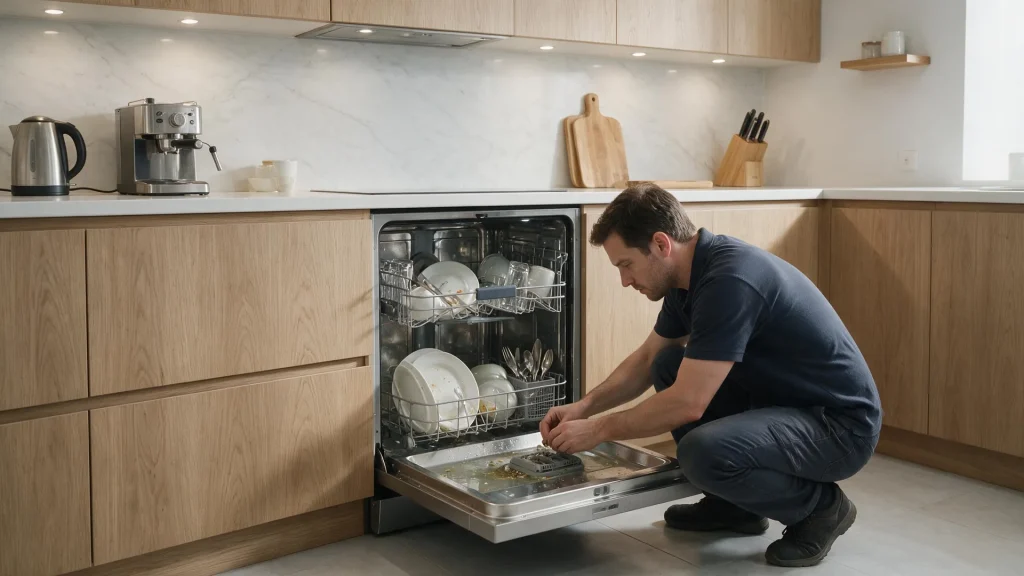
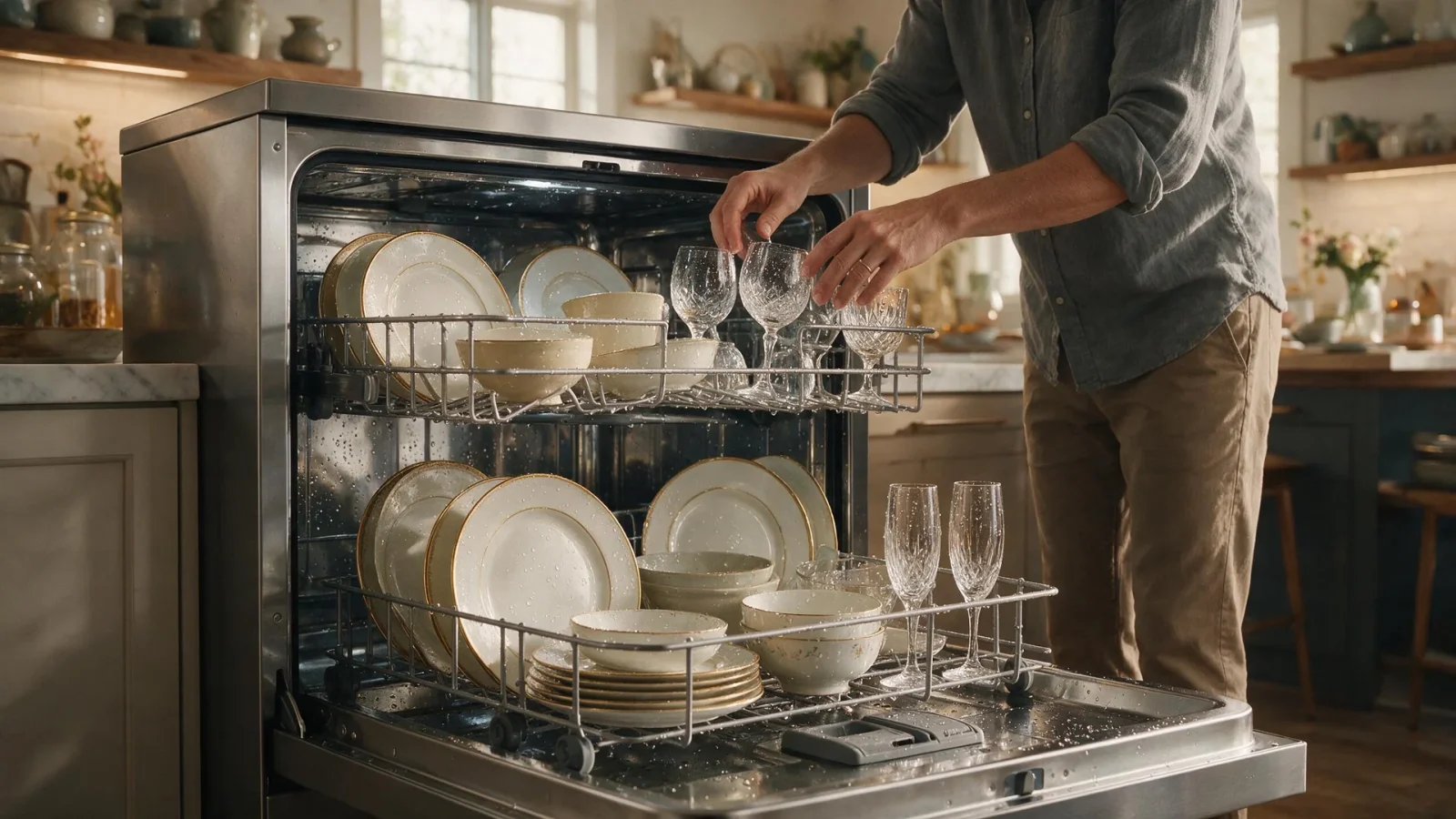

Wet plastics do not automatically mean the dishwasher is broken. Drying results depend on cycle selection, rinse aid, loading, filter cleanliness, water conditions and the material of the item being dried.
Dishes that come out wet can often be traced to rinse aid, the drying setting, loading or water temperature before the dishwasher itself is suspected, and plastics will always dry slowest. Check that liquid rinse aid is present, confirm any drying option is on, and reload so water cannot pool. If dishes stay unusually wet across normal loads, move to diagnosis.
Wet plastics do not automatically mean the dishwasher is broken. Drying results depend on cycle selection, rinse aid, loading, filter cleanliness, water conditions and the material of the item being dried.
Maintenance is most useful when it preserves the conditions the appliance needs: clean airflow, correct sealing, free drainage, appropriate loading, clean user-accessible filters and stable utilities. It cannot repair a failed motor, control, sensor, heater, valve or sealed refrigeration component.
| Symptom | What it can point to | What you can check |
|---|---|---|
| Wet plastics, dry glass and metal | Normal behavior, since plastic holds less heat | Dry plastics by hand or leave the door open once the cycle ends. |
| Everything is damp | Rinse aid empty or too low, or a drying option turned off | Check the rinse aid indicator and the drying setting for the model. |
| Water pooled in cup bottoms and dishes | Loading, with concave items tilted the wrong way | Tip bowls and cups so they face down and drain. |
| Water drips when the upper rack is pulled first | Unloading order, not a fault | Empty the lower rack first, then the upper one. |
Do not turn routine care into disassembly. Use the cleaning and maintenance instructions for the exact Dacor model, especially around filters, burner parts, water systems and removable dishwasher components.
The 24-inch Dacor dishwasher manual says rinse aid improves drying and that only liquid rinse aid should be used, because powder can clog the reservoir opening. The reservoir should not be overfilled. A Rinse Refill indicator lights when it is empty, and the dispensing amount is set on a scale from F0 to F6 on that model.
Low water temperature and overloaded racks are also listed as causes of poor drying. A load that nests bowls and plates tightly keeps water in contact with the dishes, so the result depends on how the racks were filled. Spacing items so air can move between them often changes the result more than any setting.
The best maintenance clue is often a trend: ice production slows, condensation increases, cycles take longer, drying becomes less consistent, a burner needs more attempts to light, or a control behaves differently after a power interruption.
Write down the first change. That gives a technician a timeline if maintenance no longer solves the problem.
On models with Auto Release Dry, the door opens by itself between 1 and 15 minutes before the cycle ends to improve drying, according to the manual. A door that has opened slightly after the cycle to let steam out is described there as normal.
That matters because a cracked-open door can look like a latch failure. If your model has the feature, check the manual before concluding anything, and note that turning Auto Release Dry off is listed as a reason for dishes not drying.
If dishes remain unusually wet across normal loads and settings, or the dishwasher never develops expected heat/drying behavior, maintenance should give way to diagnosis.
At that point, repeating the same cleaning or reset is unlikely to solve an internal component problem. Use Standing Water in a Dacor Dishwasher: The Drain Problem Is Usually a Sequence, Not a Single Part or What Changes the Cost of a Dacor Dishwasher Leak Repair? if the symptom has shifted into a troubleshooting or common-problem pattern.
Use `/services/dacor-dishwasher-repair/` and `/appliances/dacor-dishwashers/` for a relevant internal route. Model-specific care should connect to `/dacor-models/` when the exact model page exists.
For water-using appliances, note filter changes, leak/condensation patterns and water-flow changes. For cooking appliances, note ignition changes, preheat behavior and whether a problem appears in one zone or mode. For refrigeration, keep actual temperature readings rather than relying only on “feels warm.”
A dishwasher symptom should be tied to the stage of the cycle. “Stopped working” is less useful than “fills but does not circulate,” “washes but leaves water at the end,” or “finishes but dishes remain wet.” If a code appears, photograph it and note whether it occurs during fill, wash, drain or drying.
Panel-ready installations should stay in place until service needs access. Pulling the unit without protecting water, drain, electrical and cabinetry connections can create a leak or alignment problem that was not part of the original complaint.
No. It reduces avoidable problems and helps you notice change earlier, but components still wear or fail.
Use only products and methods appropriate to the surface and exact model instructions. Harsh cleaners can damage finishes, seals or sensors.
When the same symptom returns after correct care, when there is a code, or when the next step would require internal electrical, gas, sealed-refrigeration or microwave work.
Plastic stores less heat than glass or ceramic, so water tends to stay on it. That alone does not mean the dishwasher is faulty.
The manual for one 24-inch Dacor model says to use liquid rinse aid only, since powder clogs the reservoir opening. Confirm this in the manual for your own model.
Yes. The same manual lists unloading the upper rack first as a reason for dripping water on the dishes below.
Dacor dishwasher repair: common problems, safe checks, model and error-code resources, and when to book professional dishwasher service.
Dacor dishwashers: models, common problems, error-code resources, troubleshooting guides, and repair links in one model-aware hub.
Water left in the bottom of a dishwasher after the cycle can come from a blocked filter area, a kinked or restricted drain path,…
Dishwasher leak pricing depends on the leak path. Door-area water, a loose visible connection, a drain or fill problem, an internal pump/seal issue and…
A dishwasher that does nothing can be caused by door/latch conditions, control lock, cycle selection or power. But a dead display after a breaker…
Share a few details and we’ll confirm an appointment. Prefer to talk? Call us and we’ll help right away.
Fields marked with * are required.