
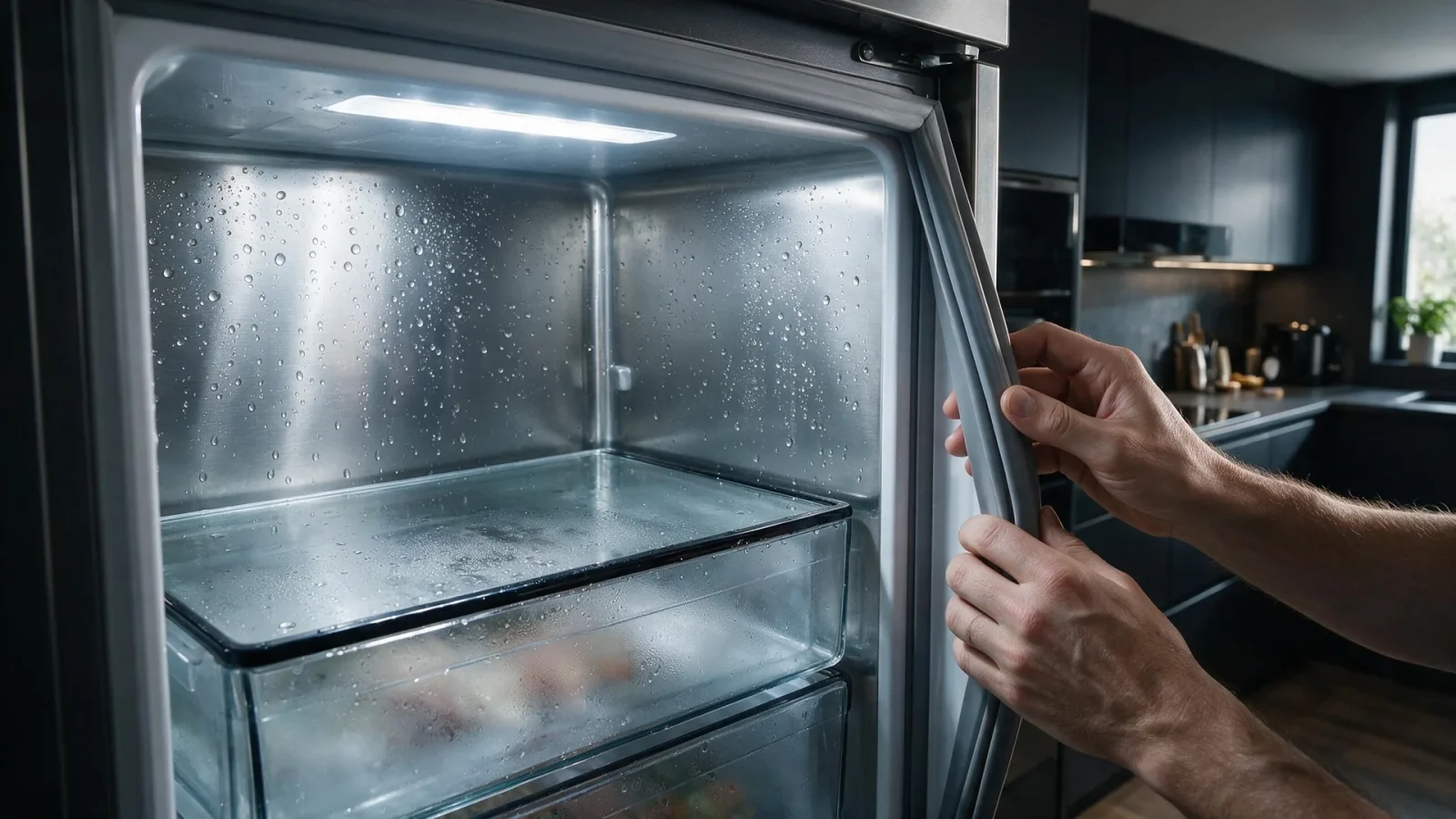

Moisture inside a refrigerator often increases when humid room air enters repeatedly or when food, containers and door alignment interfere with normal sealing and airflow.
Condensation inside a Dacor refrigerator is often a sign that humid air is getting in or that something is holding a door or vent off its normal position. Clean the seals, keep air outlets clear, cover moist foods and keep the doors closing fully. If droplets keep returning after that, the seal alignment and airflow need model-aware diagnosis.
Moisture inside a refrigerator often increases when humid room air enters repeatedly or when food, containers and door alignment interfere with normal sealing and airflow.
Maintenance is most useful when it preserves the conditions the appliance needs: clean airflow, correct sealing, free drainage, appropriate loading, clean user-accessible filters and stable utilities. It cannot repair a failed motor, control, sensor, heater, valve or sealed refrigeration component.
| Symptom | What it can point to | What you can check |
|---|---|---|
| Droplets on interior walls | Door left open or opened repeatedly, or high-moisture food stored uncovered | Wrap food airtight and see whether the droplets ease with fewer door openings. |
| Frost on interior walls | A door that is not closing properly | Check that nothing blocks the door and clean the door gasket. |
| Frost around the vents | Food blocking an air outlet | Move items away from vents and compare after a day. |
| Moisture only near one door edge | A seal that is dirty or a door that rubs a panel | Wipe the seal and mating surface, and check whether the door swings freely. |
Do not turn routine care into disassembly. Use the cleaning and maintenance instructions for the exact Dacor model, especially around filters, burner parts, water systems and removable dishwasher components.
The use-and-care manuals for several Dacor refrigerators treat these separately. Condensation on interior walls is tied to a door left open or high-moisture food, frost on the walls is tied to a door not closing properly, and frost around the vents is tied to food blocking the vents. Each points in a different direction, so naming which one you have is more useful than saying the refrigerator is wet.
Normal sounds are also listed in those manuals, including the sizzle of the defrost heater, bubbling refrigerant, fan sounds and knocks as plastic expands. None of these means that moisture is a fault, but together they help separate normal operation from something new.
The best maintenance clue is often a trend: ice production slows, condensation increases, cycles take longer, drying becomes less consistent, a burner needs more attempts to light, or a control behaves differently after a power interruption.
Write down the first change. That gives a technician a timeline if maintenance no longer solves the problem.
Manuals for several Dacor refrigerators list insufficient clearance among the causes of a warm refrigerator, citing about 5 cm at the rear and sides. A unit crowded into its opening can struggle with airflow, which can show up as temperature changes and moisture.
A door-open alarm sounds on many models after a door has been left open for about 2 minutes, and it is on by factory default. If you have heard it, you know that humid room air got in.
Hot dishes are worth a second thought as well. Steam from warm food adds moisture in one burst, and covering containers or letting them cool first keeps that load out of the compartment.
Persistent condensation after basic seal/airflow care can point to alignment, sensing, defrost, airflow or cooling issues. Document where droplets form before service.
At that point, repeating the same cleaning or reset is unlikely to solve an internal component problem. Use Dacor Refrigerator Not Cooling: Read the Pattern Before You Guess the Part or Dacor Refrigerator Temperature Keeps Moving Up and Down: What the Cycle Can Tell You if the symptom has shifted into a troubleshooting or common-problem pattern.
Use `/services/dacor-refrigerator-repair/` and `/appliances/dacor-french-door-refrigerators/` for a relevant internal route. Model-specific care should connect to `/dacor-models/` when the exact model page exists.
A refrigerator that sweats after a holiday weekend of heavy use and settles afterward has told you about habits and load. One that keeps collecting moisture with the doors closed and the shelves clear has told you something different, and that is the case to bring to service.
Neither pattern identifies a failed part on its own. What they do is help a technician decide whether to start with the door and seal geometry, the airflow around the food, or the cooling cycle.
For water-using appliances, note filter changes, leak/condensation patterns and water-flow changes. For cooking appliances, note ignition changes, preheat behavior and whether a problem appears in one zone or mode. For refrigeration, keep actual temperature readings rather than relying only on “feels warm.”
Dacor refrigeration includes French-door, column, side-by-side, undercounter and wine-storage configurations across different generations. Do not assume a procedure or component from one family applies to another. The exact model number is the safest bridge between a symptom and the correct service information.
For panel-ready or built-in units, cabinet fit and ventilation matter. A door that rubs a panel, a grille that is obstructed, or an installation that restricts airflow can change temperature or condensation behavior without producing the same diagnosis as an internal cooling-system failure.
No. It reduces avoidable problems and helps you notice change earlier, but components still wear or fail.
Use only products and methods appropriate to the surface and exact model instructions. Harsh cleaners can damage finishes, seals or sensors.
When the same symptom returns after correct care, when there is a code, or when the next step would require internal electrical, gas, sealed-refrigeration or microwave work.
Some moisture can appear when the door is opened often or warm, moist food is stored uncovered. The manual advice is to wrap food airtight and keep the door closing properly.
No. Frost on the walls points to a door that is not closing properly, while frost near the vents points to food blocking airflow.
On the refrigerator models covered in these manuals, cleaning the door gasket is part of the guidance for frost. Oven gaskets are the opposite, so use the manual for the appliance in question.
Dacor refrigerator repair: common problems, safe checks, model and error-code resources, and when to book professional refrigerator service.
Dacor french door refrigerators: models, common problems, error-code resources, troubleshooting guides, and repair links in one model-aware hub.
A Dacor refrigerator that is clearly warmer than normal can point to airflow, door sealing, temperature settings, a cooling-system problem, or a condition around…
A refrigerator that reaches temperature and then drifts can be more informative than one that never cools at all. Timing, door use, recent loading,…
When the freezer still performs but the refrigerator section warms, the estimate depends heavily on whether the cause is airflow, a fan/damper issue, sensor/control…
Share a few details and we’ll confirm an appointment. Prefer to talk? Call us and we’ll help right away.
Fields marked with * are required.